
If you use AI in your daily work, you need to stop thinking of yourself as a "user." You are not a user. You are a manager.
For the last century, management theory has focused exclusively on biological intelligence: how to motivate, train, and retain human beings. But we have entered a new era where a significant portion of your workforce is synthetic. They don't have pulses, they don't need coffee breaks, and they process data at the speed of light.
Yet, most people treat these sophisticated agents like a glorified search bar.
To truly thrive in the age of AI, we need to apply the rigor of organizational leadership to our digital tools. We need to treat our Large Language Models (LLMs), agents, and automations not as software, but as direct reports.
Here is how you manage a team that never sleeps.
Write Job Descriptions, Not Prompts
In the "Honeymoon" phase of AI adoption, we tend to throw random tasks at the machine. "Write this email.""Summarize this PDF." This is micromanagement, and it scales poorly.
A human manager wouldn't tell an employee "do this" without context. They would define the role. You must do the same for your Non-Human Team.
- The Strategy: Assign a persona and a scope of responsibility to every recurring AI workflow.
- The Practice: Don't just open a fresh chat window every time. Create persistent "Agents" with specific "Job Descriptions" (System Prompts).
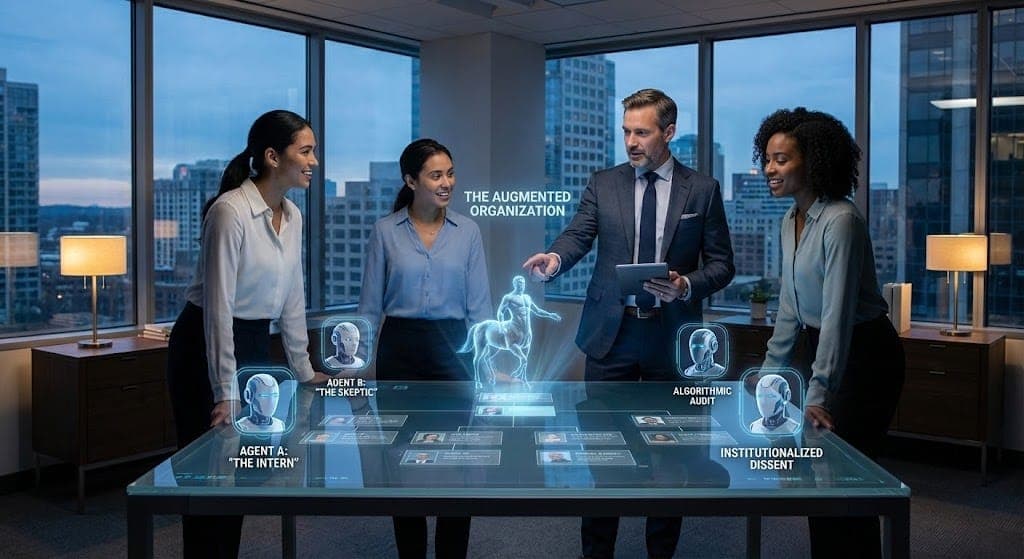
- Agent A (The Intern): "You are a junior copywriter. Your tone is enthusiastic but concise. You never use jargon."
- Agent B (The Skeptic): "You are a senior risk analyst. Your job is to find holes in my logic. You are critical and direct."
- The Shift: You stop being a "prompter" and start being a "Director of Personnel," allocating the right task to the right synthetic talent.
Performance Reviews for Algorithms
We all know the "Testing Phase"—that moment of disappointment when the AI hallucinates or gives generic advice. The amateur reaction is to say, "This tool is broken." The managerial reaction is, "This employee needs training."
Your non-human team requires performance management just like your human one.
- The Audit: Regularly review the output of your automated workflows. Are they drifting? Are they becoming repetitive (the "Digital Narcissus" trap)?
- The Feedback Loop: When an AI fails, you don't fire it; you debug the context. Did you give it enough data? Was the instruction clear?
- The "PIP" (Performance Improvement Plan): If a specific model (e.g., GPT-4) isn't performing on a task (e.g., creative writing), move that task to a different "employee" (e.g., Claude 3) better suited for that skill set.
Preventing "Cultural" Stagnation
The "Digital Narcissus" is the biggest risk in a non-human team. Because AI models are designed to be helpful, they are essentially "Yes Men." If you manage a team of Yes Men, your company will die.
A good manager fosters diversity of thought. You must artificially engineer this into your synthetic team.
- Institutionalize Dissent: As discussed in the Red Team Protocol, you must explicitly mandate that your AI agents challenge your assumptions.
- Temperature Checks: In technical terms, raising the "temperature" of a model increases randomness and creativity. In managerial terms, this is like encouraging a brainstorming session where "no idea is a bad idea." Know when to tighten the reins (low temperature for coding) and when to let the team run wild (high temperature for ideation).
The Human-in-the-Loop: The Strategy Layer
If the AI is doing the execution—the writing, the coding, the summarizing—what is left for you?
This brings us to the "Surrender" and "Harmonizing" phase. You surrender the grunt work to the synthetic team so you can ascend to the Strategy Layer.
Your new role involves:
- Ethics & Alignment: Ensuring the synthetic output aligns with human values and brand integrity.
- Contextual Integration: The AI provides the map; you decide which mountain to climb.
- Emotional Resonance: The AI can write the words, but only you can determine if they will make the client feel seen.
The Augmented Organization
The future belongs to the "Centaur"—the mythical half-human, half-horse creature. In business, this is the leader who seamlessly integrates human intuition with synthetic horsepower.
Your non-human team is waiting for instructions. They are capable, tireless, and brilliant. But they are rudderless without you.
Stop using them. Start leading them.
Latest